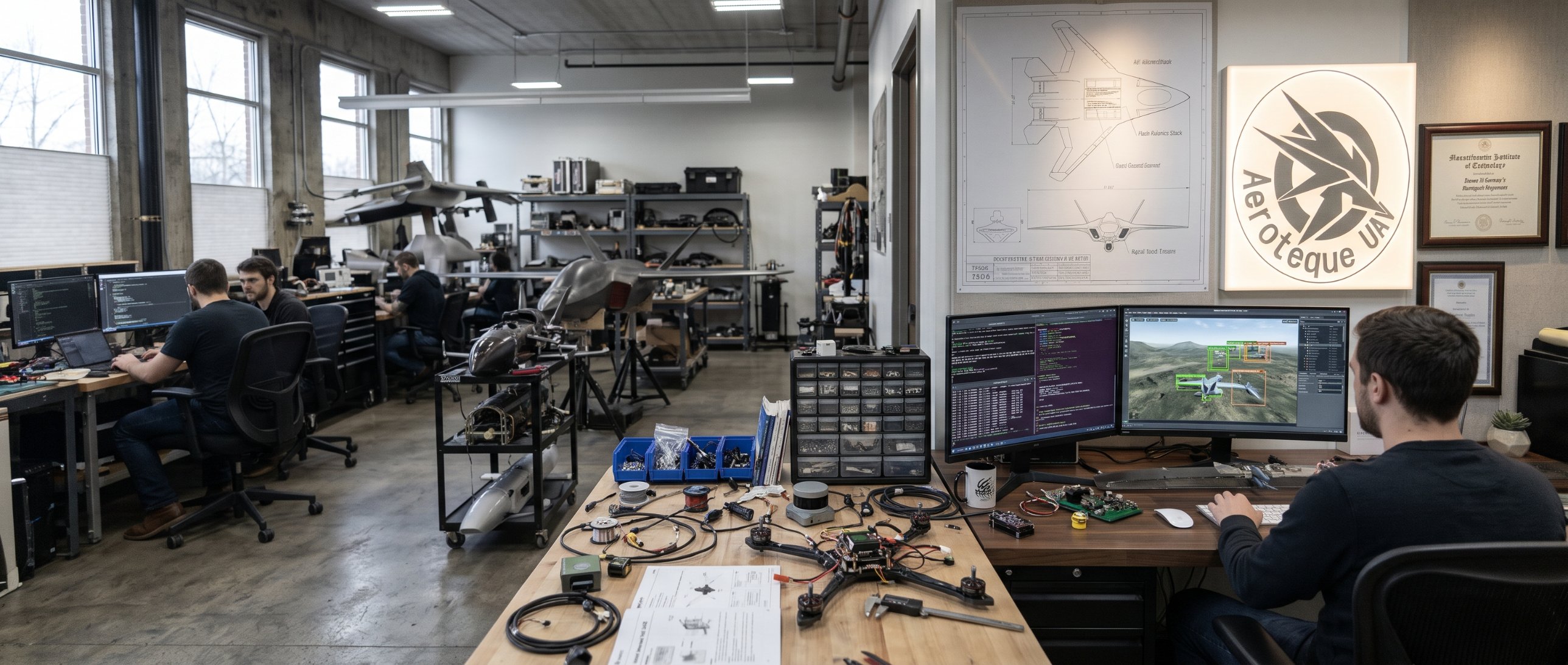
Platforms that see, decide and act
From remote flight to missions flown on their own
We build the autonomy stack end to end: navigation, perception, estimation and decisions, developed in simulation and proven on real hardware.
Written for the sensors and processors it will run on, so what works in simulation keeps working in the air.
What we deliver
Eight autonomy and AI services, from perception to mission assurance
01Navigation
Autonomous navigation & mission planning
Platforms that fly the mission, not the pilot: route planning, take-off to landing, and decisions when the plan meets reality.
- Waypoint, area-coverage and corridor missions
- Path planning and obstacle avoidance
- Precision landing and landing-site selection
- Operation with degraded or denied GNSS using visual and inertial navigation
02Perception
Computer vision & onboard perception
Cameras and sensors turned into understanding: detection, classification, tracking and segmentation, running on the aircraft itself.
- Object detection, classification and tracking
- Semantic segmentation for terrain and crops
- Visual odometry and landmark recognition
- Multi-camera, thermal and LiDAR perception
03Machine learning
AI model development & training in simulation
Models trained on large volumes of synthetic and real data, in simulated environments, so they have seen the edge cases before the aircraft has.
- Synthetic data generation and domain randomisation
- Dataset design, labelling and curation
- Model training, evaluation and regression testing
- Sim-to-real validation
04State estimation
Sensor fusion & state estimation
One reliable picture of where the aircraft is and what it is doing, built from imperfect sensors.
- Extended Kalman filter design and tuning
- GNSS, IMU, barometer, magnetometer and airspeed fusion
- Vision and LiDAR-aided estimation
- Sensor fault detection and fallback
05Tracking
Target tracking & gimbal pointing control
A moving target kept in frame: the camera and aircraft working together to acquire it, follow it and report where it is.
- Target acquisition and persistent tracking
- Predictive following of moving vehicles and ground stations
- Gimbal stabilisation and pointing control
- Geo-location of tracked targets
06Edge AI
Edge deployment & optimisation
Models and algorithms engineered to run in real time inside the weight, power and thermal limits of a small aircraft.
- Model compression, quantisation and acceleration
- Embedded GPU, CPU and accelerator deployment
- Latency and power profiling
- Onboard software architecture and task scheduling
07Multi-vehicle
Multi-vehicle coordination
Several platforms working as one system, sharing tasks and data over resilient links.
- Task allocation and shared mission planning
- Shared situational awareness across vehicles
- Formation and area-sharing behaviour
- Ground-station supervision of multiple vehicles
08Assurance
Safety, failsafes & mission assurance
Autonomy that stays predictable: deterministic fallbacks, bounded behaviour and an operator who can always take over.
- Geofencing and flight-envelope protection
- Link-loss, low-battery and sensor-failure behaviour
- Deterministic fallbacks around AI components
- Operator override and supervision interfaces